
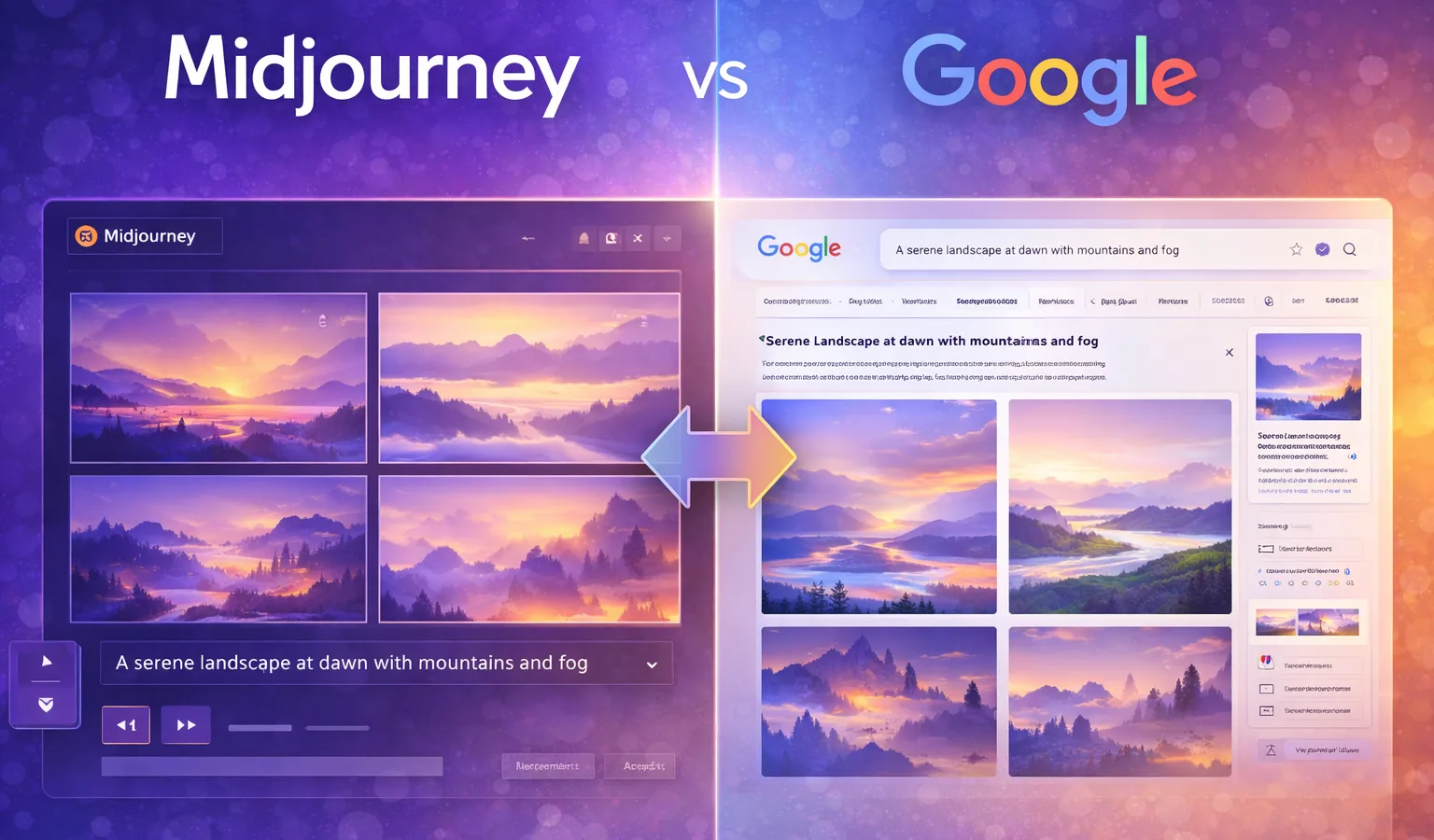
At first glance, Midjourney and Google do not look like direct competitors.
One is an AI image generator. The other is the world’s biggest search engine.
But in practice, people often use both for the same early-stage job: visual discovery.
If you are trying to explore a creative direction, gather references, understand a style, or turn a vague idea into something visible, both tools can play a role. They just do it differently.
Quick verdict
If you want the short version:
- Choose Midjourney if you want to create new visual directions fast.
- Choose Google if you want to discover what already exists and validate ideas against real-world references.
Overview
| Feature | Midjourney | |
|---|---|---|
| Creative ideation | ⭐⭐⭐⭐⭐ | ⭐⭐⭐ |
| Real-world reference search | ⭐⭐ | ⭐⭐⭐⭐⭐ |
| Speed to inspiration | ⭐⭐⭐⭐⭐ | ⭐⭐⭐⭐ |
| Search breadth | ⭐ | ⭐⭐⭐⭐⭐ |
| Original image creation | ⭐⭐⭐⭐⭐ | ⭐ |
What Midjourney does best
Midjourney is useful when the problem is not “find examples,” but “create possibilities.”
It is especially strong for:
- concept ideation
- exploring visual styles
- generating moodboards
- trying multiple directions quickly
- creating images that do not already exist
Strengths
- excellent for fast visual ideation
- powerful for mood, style, and concept exploration
- useful at the earliest stage of a creative process
Weaknesses
- not a reference search engine
- may create beautiful outputs that are not grounded in real-world feasibility
- less useful when you need real examples, products, or factual visuals
What Google does best
Google is still far better when you need to discover existing information.
It works best for:
- finding real-world references
- exploring existing design patterns
- validating whether an idea already exists
- shopping or product discovery
- researching photography, architecture, UI, branding, and trends
Strengths
- unmatched breadth of real-world content
- ideal for validation and reference gathering
- useful across images, web, shopping, maps, and video
Weaknesses
- less useful for original creation
- inspiration process can be slower and more fragmented
- often requires browsing many results
Best use cases for Midjourney
Use Midjourney when you want to:
- invent visual directions
- explore concepts quickly
- generate options for editorial covers
- create mood-rich inspiration that is not limited to existing references
Best use cases for Google
Use Google when you want to:
- find real designs, products, and references
- validate trends
- gather examples for art direction
- understand the visual landscape before creating something new
The best workflow is often both
For many creative workflows, Midjourney and Google are not replacements for each other.
A practical stack looks like this:
- Google for research and references
- Midjourney for ideation and exploration
That sequence is powerful because it combines grounding with originality.
Final verdict
This is not really a battle between two direct substitutes.
It is a comparison between:
- a tool that helps you discover what exists
- and a tool that helps you imagine what could exist
Use Google when truth, references, and breadth matter.
Use Midjourney when you need to move from vague idea to visual direction fast.
If your work includes creative strategy, content, design, or branding, the strongest answer is usually: use both, in that order.