
If you work with information for a living — writing, researching, analyzing, advising — something fundamental is shifting in how that work gets done.
It’s not dramatic or sudden. But if you pay attention, you can feel it.
The part of your job that used to take the most time is getting faster. And the part that actually matters — the judgment, the decisions, the things only you can figure out — is becoming the whole job.
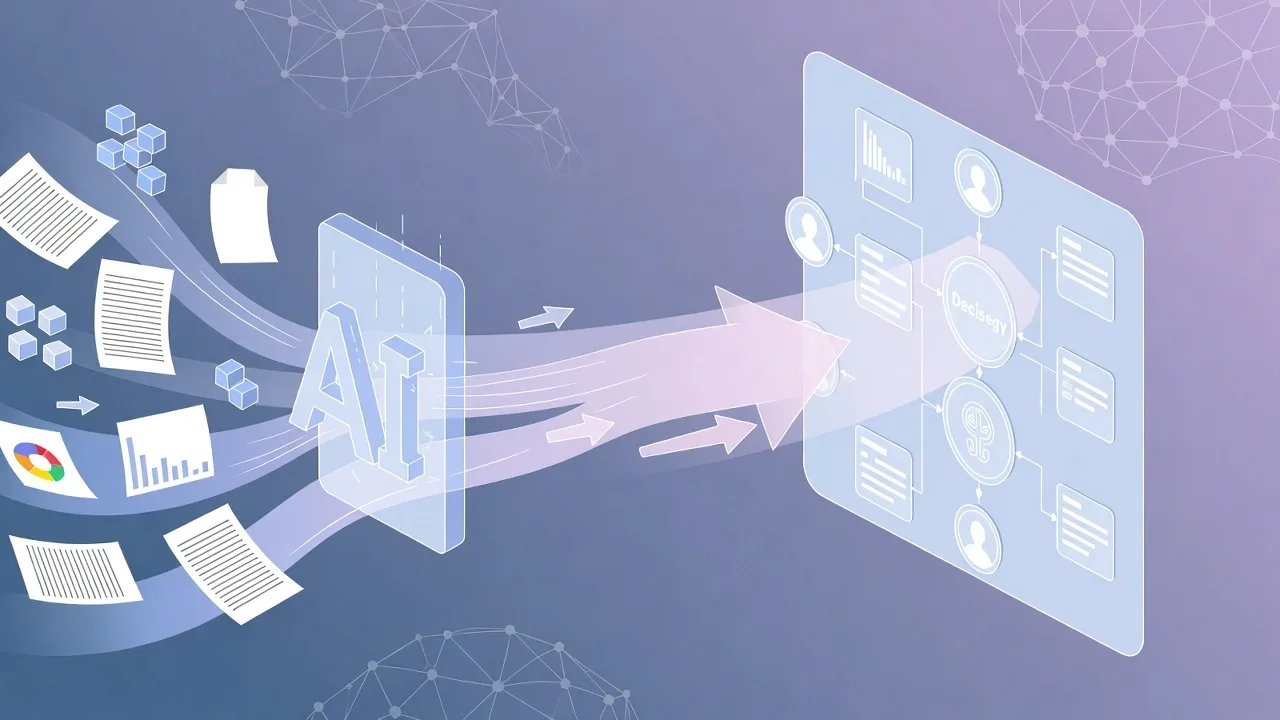
This is the shift from information work to decision work. Understanding it is one of the most useful things you can do for your career in the AI era.
What Information Work Actually Looked Like
For most of the last few decades, a huge chunk of knowledge work was really just information processing. Finding it, organizing it, summarizing it, moving it from one place to another.
A junior analyst spent most of their day pulling data and building spreadsheets. A researcher spent hours locating sources before they could start thinking about what the sources meant. A consultant spent a week gathering information before they could spend a day developing recommendations.
Nobody called it information processing. It was just “doing the work.” But that’s what it was — and it consumed an enormous amount of time.
What Changed: AI Handles the Processing
AI tools have quietly taken over a large part of that processing layer.
Research that used to take a day now takes an hour. Summaries that used to take a morning now take minutes. First drafts that used to take an afternoon now take twenty minutes to generate and another twenty to edit into something good.
The processing is still happening. It’s just not happening at human speed anymore.
And that changes the economics of knowledge work.
If processing information is no longer the bottleneck, the obvious question becomes: what is?
What Decision Work Means
Decision work is the part of knowledge work where the value comes from interpreting information and deciding what to do with it.
Instead of simply collecting or summarizing information, decision work focuses on:
- interpreting context
- evaluating tradeoffs
- choosing between alternatives
- deciding what actions to take
AI can process information extremely quickly. But deciding what that information means in a real situation still requires human judgment.
The New Bottleneck: Decisions
When information moves fast and cheaply, the thing that slows everything down is deciding what to do with it.
Anyone can get a summary of the latest research on a topic. Not everyone can look at that research and figure out what it actually means for their specific situation — their team, their client, their project, their constraints.
Anyone can generate ten strategic options. Not everyone can evaluate which one is right given everything they know that isn’t in the document.
Anyone can produce a report. Not everyone can decide what the report needs to say to actually change how someone thinks.
That gap — between having information and knowing what to do with it — is where the value is now.
AI doesn’t close that gap. In many ways it makes it wider, because the information arrives faster than ever and someone still has to decide what it means.
What Decision Work Actually Looks Like
Decision work is harder to describe than information work because it’s less visible. It often looks like thinking, conversation, or reflection.
But concretely, it includes things like:
Choosing what questions to ask.
Not just answering questions — deciding which questions are worth asking in the first place.
Evaluating tradeoffs.
Most real decisions involve giving something up to get something else. AI can show options, but it can’t weigh the real-world consequences.
Reading context.
Knowing when a technically correct answer is wrong for a specific client, team, or moment.
Taking responsibility.
When a decision turns out to be wrong, someone has to own it. That person won’t be the AI.
Accountability remains entirely human.
Why This Matters for Your Career
If you’ve been measuring your value by how much you produce — how many reports, how many articles, how many analyses — this shift is worth paying attention to.
Production is getting commoditized. Not worthless, but no longer the differentiator it used to be.
The person who produces twice as much as everyone else isn’t as impressive when AI helps everyone produce twice as much.
What’s becoming more valuable:
Knowing which problems are worth solving.
Anyone can answer a question. Figuring out which questions actually matter takes deeper understanding.
Having real expertise.
General knowledge is getting cheaper by the day. Deep, specific expertise is becoming more valuable.
Making calls under uncertainty.
Most important decisions don’t have clean answers. The ability to make a reasonable call with incomplete information is rare.
Building trust.
Clients and colleagues trust people, not outputs. Judgment built through experience still matters.
How to Make the Shift
If you’re still spending most of your time on the processing layer — finding information, organizing it, summarizing it — the shift is straightforward in principle.
Use AI for the processing.
Research, summarizing, drafting, organizing — let AI handle the mechanical parts.
Spend the time you save on decisions.
Ask better questions. Interpret the results. Decide what actually matters.
Get comfortable with uncertainty.
Decision work rarely has a perfect answer. You make the best call you can and move forward.
Develop your point of view.
Information is abundant. Perspective is rare.
The Honest Take
This shift isn’t comfortable for everyone.
Many professionals built their identity around being the person who processes information well — who researches thoroughly, writes clearly, produces reliably.
Those skills still matter. They’re just table stakes now, not differentiators.
The people who will do best are the ones who move up the stack — from processing to deciding, from producing to judging, from answering questions to asking better ones.
That’s not a threat. It’s an opportunity.
The work that remains after AI handles the processing is, by definition, the most interesting and valuable work.
TL;DR — The Short Version
- For decades, knowledge work was mostly information processing
- AI tools now handle much of that processing layer
- The new bottleneck is decisions — interpreting information and deciding what to do with it
- Decision work includes choosing questions, evaluating tradeoffs, reading context, and taking responsibility
- The most valuable skills in the AI era: judgment, expertise, perspective, and trust
Use AI for the processing.
Spend the time you save on the decisions that actually matter.
The job isn’t disappearing.
It’s becoming more human.