
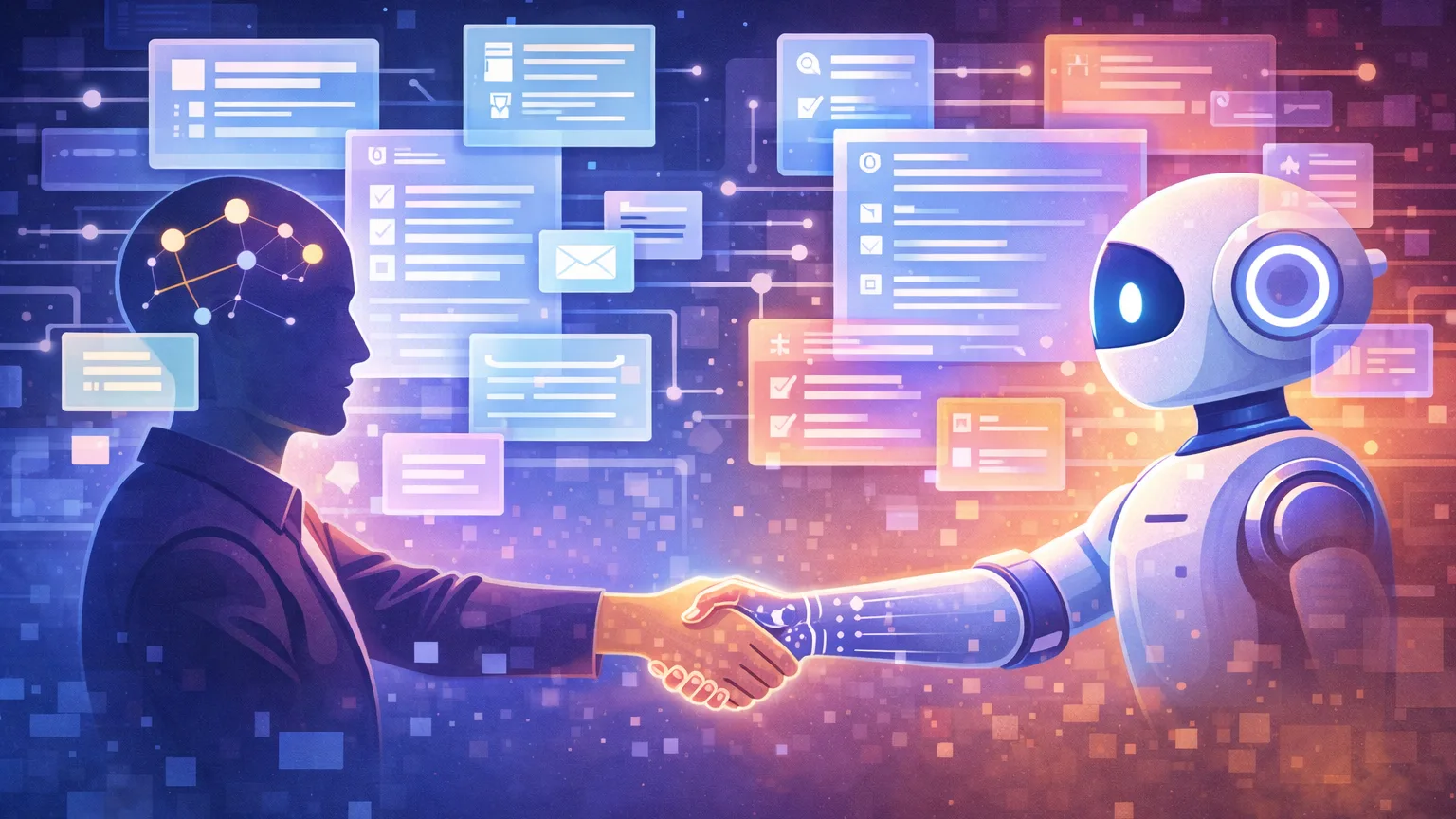
Artificial intelligence is becoming a common tool in professional environments.
But despite the rapid growth of AI tools, many organizations are still asking the same question: how should humans actually work with AI?
The goal is not replacing people with automation. The most effective teams are learning how to combine human judgment with AI capabilities.
In 2026, the most productive workflows are not purely human or purely automated. They are collaborative systems where AI assists people at different stages of the work process.
This article explores how human + AI collaboration works in practice and which patterns actually improve productivity.
Why collaboration matters more than automation
Early discussions about AI often focused on automation.
The idea was simple: if a machine can perform a task, it should replace the human doing it.
In practice, most knowledge work tasks are too complex for full automation. They require interpretation, judgment, and contextual understanding.
Instead of replacing people, AI tools are increasingly used to augment human work.
AI can process information quickly, but humans still provide:
- context
- critical thinking
- strategic judgment
- creative direction
The most effective workflows combine these strengths.
1. AI as a research assistant
One of the most common collaboration patterns is using AI as a research assistant.
Professionals often need to explore new topics, understand complex subjects, or gather supporting information.
AI tools can significantly accelerate this stage.
What AI does well
AI can help with:
- summarizing articles
- comparing multiple sources
- explaining unfamiliar topics
- extracting key insights
This reduces the time required to move from question to understanding.
What humans still do
Humans still verify sources, interpret results, and decide how the information should be used.
In this model, AI helps gather and structure information while people remain responsible for evaluating it.
2. AI as a drafting partner
Writing is another area where collaboration between humans and AI works particularly well.
Many professionals use AI tools to generate outlines, rough drafts, or alternative phrasings.
Typical workflow
A common writing workflow looks like this:
- A human defines the topic and structure
- AI generates a draft or outline
- The human edits, restructures, and improves the content
This approach significantly speeds up writing while maintaining human oversight.
The AI assists with structure and wording, while the human focuses on clarity, accuracy, and intent.
3. AI as an information filter
Modern professionals face an enormous amount of information every day.
Reports, messages, dashboards, and research materials compete for attention.
AI tools help filter this information and highlight the most relevant insights.
Examples of filtering tasks
AI can:
- summarize long documents
- extract key points from reports
- highlight important trends
- organize notes and knowledge
This allows professionals to focus on the information that actually matters.
Instead of reading everything manually, people can review condensed insights generated by AI.
4. AI as a decision support tool
Decision making is another area where human and AI collaboration can be powerful.
AI systems can analyze large datasets and identify patterns that might not be immediately visible.
How AI supports decisions
AI tools can assist with:
- analyzing data
- identifying trends
- comparing options
- generating scenario summaries
However, AI typically provides analysis rather than final decisions.
Humans still evaluate trade-offs, consider context, and determine the best course of action.
This creates a workflow where AI expands the range of insights available to decision makers.
Common mistakes in human + AI collaboration
Despite the benefits, some teams struggle to integrate AI effectively.
Two common mistakes appear frequently.
Expecting AI to replace expertise
AI tools are powerful, but they do not replace professional judgment.
When teams rely on AI outputs without review, the quality of decisions often declines.
Treating AI as a novelty
On the other hand, some teams experiment with AI occasionally but never integrate it into daily workflows.
The real benefits appear when AI becomes part of repeatable systems and processes.
The future of collaborative work
As AI tools continue to improve, collaboration between humans and machines will become more structured.
Instead of isolated tools, organizations will build workflows where AI assists at specific stages of work:
- research
- drafting
- analysis
- summarization
- decision support
The human role shifts toward direction, evaluation, and strategic thinking, while AI handles more of the repetitive cognitive work.
Final thoughts
Human + AI collaboration is not about replacing people with machines.
It is about combining the strengths of both.
AI excels at processing large amounts of information and generating structured outputs. Humans excel at interpreting context, making judgments, and guiding complex work.
The most productive teams in the coming years will not be those that rely solely on AI.
They will be the teams that learn how to collaborate with it effectively.