
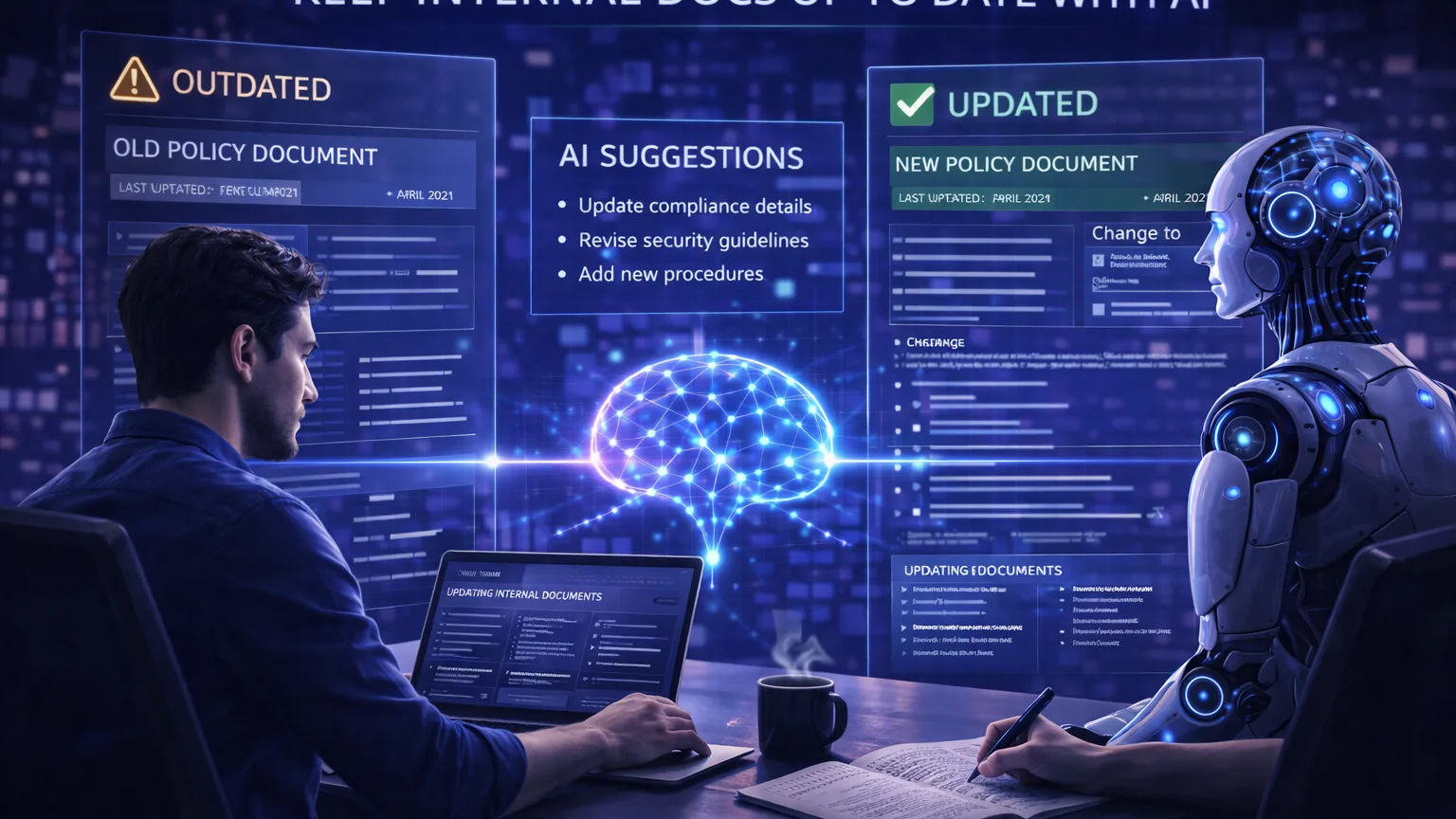
Documentation around keep internal docs up to date with ai often breaks for a simple reason: the team knows more than the system reflects.
Important steps, ownership rules, and exceptions live in memory, chat, and repeated explanations. The docs exist, but they do not stay trustworthy enough to support real work.
AI helps because it can turn scattered operational material into a clearer structure and make maintenance less painful.
This guide explains how to approach keep internal docs up to date with ai in 2026 so the documentation becomes something people actually use.
What the documentation needs to do
Good documentation is not measured by word count. It is measured by whether someone can use it to move work forward correctly.
For keep internal docs up to date with ai, the docs should help someone:
- understand the purpose of the process or system
- find the right starting point quickly
- follow the current approved path
- see who owns the page and when it was last reviewed
If the document cannot do those things, it may still look polished while failing operationally.
Start from the workflow, not from the page
The fastest way to create weak documentation is to start by writing a page without understanding how the work really happens.
Instead, begin by mapping the actual process:
- what triggers the work
- who touches it
- what tools or inputs are required
- what exceptions come up repeatedly
Once those things are clear, AI becomes much more useful. It can restructure rough notes into SOPs, runbooks, playbooks, checklists, or decision logs without inventing the workflow from scratch.
Use templates to make the system coherent
Documentation quality scales better when the format is predictable. For a topic like keep internal docs up to date with ai, the team should decide what type of page they are creating before drafting begins.
Useful templates often include:
- overview pages for orientation
- SOPs for repeatable steps
- runbooks for response situations
- decision logs for rationale and changes
- checklists for execution support
When AI works inside those templates, output becomes more consistent and easier to review.
Where AI helps most
AI is strongest when it:
- summarizes large source material into a smaller structure
- suggests missing sections or weak explanations
- turns informal process notes into cleaner document drafts
- helps compare current docs against recent changes or new evidence
That is much more useful than asking it to generate documentation with no reliable source material behind it.
What to review on a regular cadence
Even well-written docs decay when the system around them changes. For keep internal docs up to date with ai, the team should routinely review:
- whether the documented steps still match the live process
- whether ownership is still current
- whether old links, references, or tools have gone stale
- whether a stronger summary or clearer start point is needed
This review does not need to be heavy. A light monthly or quarterly pass is often enough for high-value pages.
Maintenance matters more than the first draft
Most documentation systems fail after the initial publish. The page goes stale, ownership becomes unclear, and related pages drift out of sync.
For keep internal docs up to date with ai, maintenance should be built into the process:
- assign an owner
- set a review cadence
- define what changes should trigger a rewrite
- archive or redirect old pages that no longer reflect the approved workflow
AI can reduce the effort of this maintenance by flagging likely drift and drafting the first revision, but the owner should still approve the final update.
Common mistakes
The most common problems in AI-assisted documentation are:
- pages that describe idealized work instead of real work
- templates that are too loose to be consistent
- documentation with no ownership or review cadence
- search systems trying to compensate for weak page quality
These issues are usually process problems, not tool problems.
How to keep the system trusted
Trust is the real currency of internal documentation. Once people see several pages that are outdated or vague, they start routing around the system entirely.
That is why the documentation process for keep internal docs up to date with ai should include:
- visible ownership
- clear review dates
- archiving of outdated pages
- links to the approved next document or source of truth
AI supports this trust when it helps make pages clearer and easier to maintain. It undermines trust when it creates more content than the team can actually govern.
Final takeaway
The right way to handle keep internal docs up to date with ai in 2026 is to treat documentation as operational infrastructure. AI can make that infrastructure faster to build and easier to maintain, but only when the workflow, ownership, and templates are clear.
The goal is not to create more pages. The goal is to create pages that stay useful, searchable, and trusted.
What to review every quarter
Documentation around keep internal docs up to date with ai gets weaker when teams assume that the page is “finished” once it is published. In practice, the document should be re-checked against the live workflow, the current owner, and the systems it references.
A good quarterly review should confirm:
- the documented process still matches what the team actually does
- links and referenced tools are still current
- exceptions and escalation rules are still accurate
- the page still answers the most common questions without extra explanation
This review loop is what keeps documentation useful instead of archival.
How to make the page easier to trust
Trust usually comes from a few simple signals: clear ownership, visible review dates, concise summaries, and consistent page structure. When those signals are present, people are much more likely to rely on the document during real work.
That matters for keep internal docs up to date with ai because the page should support action, not just store information. A slightly shorter but clearer page with visible ownership is usually more valuable than a longer page full of weak context.