
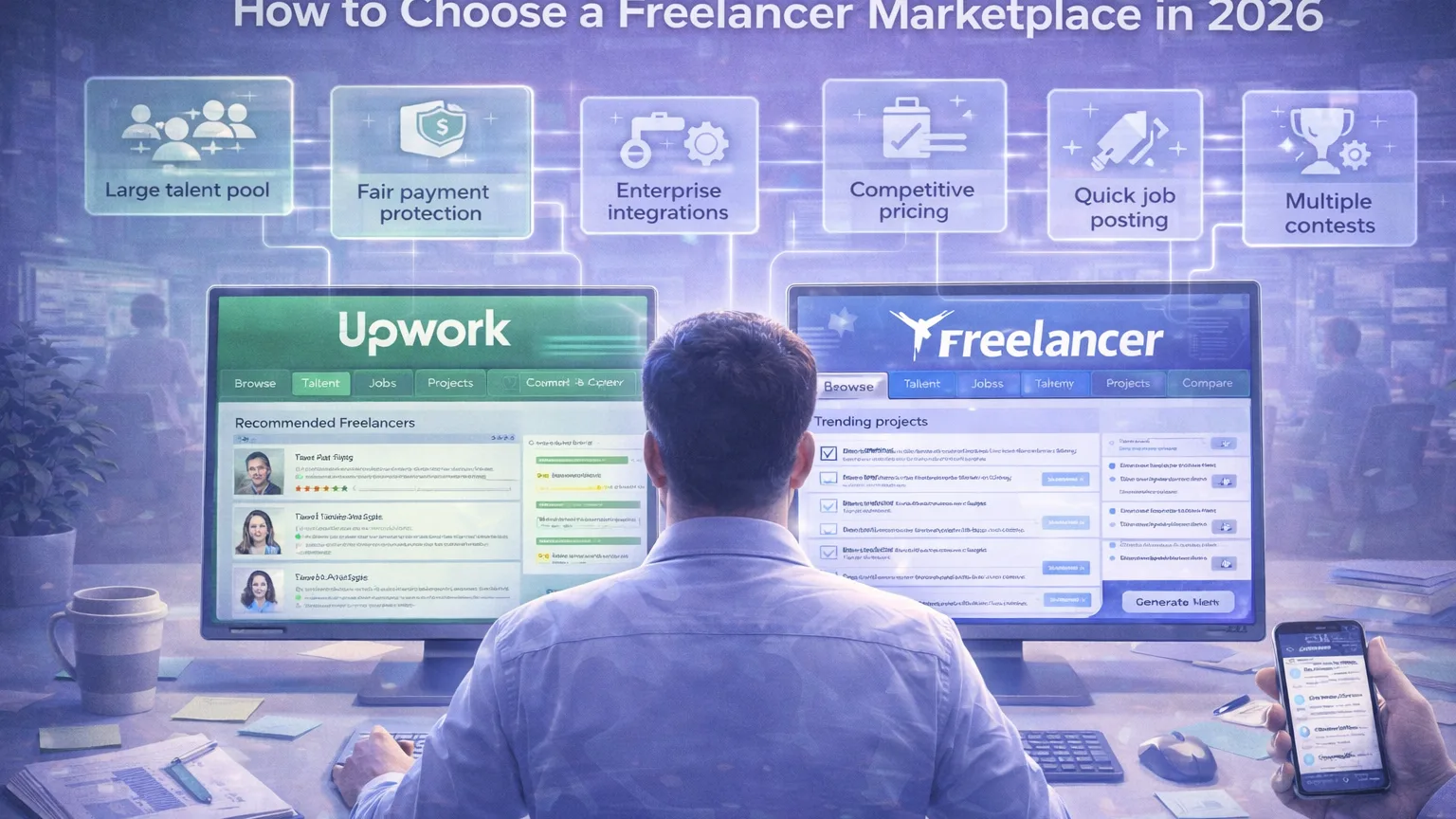
Hiring through a freelancer marketplace sounds simple until you actually need to choose one.
At first glance, many platforms promise the same thing: a large talent pool, fast hiring, secure payments, and flexible pricing. In practice, the differences matter a lot. Some marketplaces are better for structured client work. Others are better for speed, contests, or budget-sensitive tasks. Some are strong for long-term specialists. Others are better for short one-off execution.
If you choose the wrong marketplace, the cost is not just money. It is slow hiring, poor fit, extra revisions, communication overhead, and wasted time.
This guide breaks down how to choose a freelancer marketplace in 2026 without getting stuck in feature lists or marketing claims.
Start with the type of work
Before comparing platforms, define what you are actually trying to hire for.
There is a big difference between:
- a designer for a landing page refresh
- a developer for ongoing product work
- a researcher for structured sourcing
- a video editor for repeatable weekly output
- a writer for a one-time article
- a general assistant for operational tasks
A marketplace that works well for quick creative tasks may be a poor fit for technical work. A platform that is great for individual specialists may be clumsy for contest-based sourcing. The first filter should always be the type of work, not the marketplace brand.
The five factors that matter most
Most teams should evaluate freelancer marketplaces across five practical criteria.
1. Talent quality
The first question is simple: can you actually find the level of talent you need?
Look for signals like:
- quality of profiles and portfolios
- depth in your category
- review quality, not just review count
- clarity of prior work
- whether specialists or generalists dominate the platform
A large marketplace is not automatically better if most of the supply is too broad, too junior, or poorly filtered.
2. Hiring speed
Some marketplaces are optimized for speed. Others require more time to shortlist properly.
If your workflow depends on moving quickly, check:
- how fast you can publish a brief
- how quickly relevant applicants appear
- how noisy the application flow is
- how easy it is to reject poor-fit candidates
- whether the platform helps with matching or leaves everything manual
Fast does not always mean good, but slow marketplaces create real drag.
3. Payment and risk control
A freelancer marketplace should reduce risk, not just list people.
Look at:
- milestone support
- escrow or payment protection
- dispute handling
- refund logic
- clarity of fees
- invoicing workflow
This part matters much more when projects are larger, longer, or more ambiguous.
4. Workflow fit
A lot of teams underestimate this.
Even if you find a good freelancer, the platform may still be a bad fit if the operating workflow is clumsy.
Check whether it supports:
- easy messaging
- file sharing
- milestone tracking
- repeated work with the same freelancer
- team access or collaboration
- clear project history
If the platform feels awkward once the work starts, the relationship often leaves the platform anyway.
5. Total cost
Do not judge cost only by hourly rate.
The real cost includes:
- platform fees
- bad-fit hires
- time spent filtering applicants
- revisions
- management overhead
- the cost of re-hiring if the first attempt fails
Sometimes the “cheaper” marketplace becomes more expensive because the signal quality is weaker.
The three main marketplace patterns
In practice, most freelancer marketplaces fall into one of three buckets.
Structured professional marketplaces
These are strongest when you want clearer profiles, repeatable client work, and better support for longer engagements.
Best for:
- design
- development
- writing
- operations
- ongoing specialist work
Weaknesses:
- can take more time to filter well
- good talent may still be expensive
- very broad marketplaces can become noisy
Fast-task marketplaces
These work better when the job is smaller, clearer, and easier to scope.
Best for:
- quick execution
- one-off tasks
- simple creative or admin work
- experimentation
Weaknesses:
- quality variation is often higher
- communication and context may be weaker
- not always ideal for strategic or ongoing work
Contest or bid-style marketplaces
These are useful when you want multiple options quickly, especially in creative categories.
Best for:
- logos
- naming
- light design exploration
- quick option generation
Weaknesses:
- less suitable for deep collaborative work
- can optimize for volume over fit
- not ideal for complex long-term specialist hiring
A practical selection framework
If you want to choose fast, use this framework.
Choose based on work type
Use a more structured marketplace when:
- the work is technical
- the work is strategic
- you want repeatable collaboration
- project quality matters more than raw speed
Use a lighter marketplace when:
- the work is simple and scoped
- you need quick turnaround
- the risk of a bad hire is low
- you are testing a task, not building a long relationship
Use contest-based sourcing when:
- you want many creative options quickly
- the task is visually or conceptually broad
- you do not yet know the exact direction
What to avoid
There are a few common mistakes teams make when choosing freelancer platforms.
Choosing based on price alone
A lower rate often hides a higher management cost.
Using the same marketplace for every kind of work
One platform rarely fits everything equally well.
Writing weak job briefs
A bad brief will fail on almost any marketplace.
Confusing applicant volume with quality
Fifty low-fit applications are not better than five strong ones.
Ignoring post-hire workflow
The hiring experience is only the beginning. Delivery matters more.
What a good first test looks like
Instead of committing too early, run a small live test.
For example:
- write one real brief
- post it on one platform
- evaluate the first 10 to 20 relevant responses
- shortlist 2 to 3 candidates
- assign a paid trial task
- measure speed, clarity, output quality, and management effort
This gives you much better signal than comparing marketing pages.
Best use cases by team type
Solo operators
Prioritize:
- speed
- low management overhead
- clarity of pricing
- strong search and filtering
Small teams
Prioritize:
- repeatable collaboration
- milestone support
- easier communication
- solid mid-level specialist supply
Content teams
Prioritize:
- writer/editor/designer depth
- speed to shortlist
- portfolio quality
- repeat engagement support
Product or startup teams
Prioritize:
- developer/designer/operator quality
- longer engagement support
- reliable payments
- clearer history and project continuity
Final takeaway
The best freelancer marketplace is not the one with the most features.
It is the one that reduces friction between:
- the work you need done
- the quality level you need
- the speed you need
- and the amount of management overhead you can afford
If the task is strategic, choose for fit and quality. If the task is simple, choose for speed and clarity. If the task is creative and broad, choose for option volume.
A good marketplace should help you find the right person faster and make the working relationship easier once the project starts.
That is the real benchmark.