
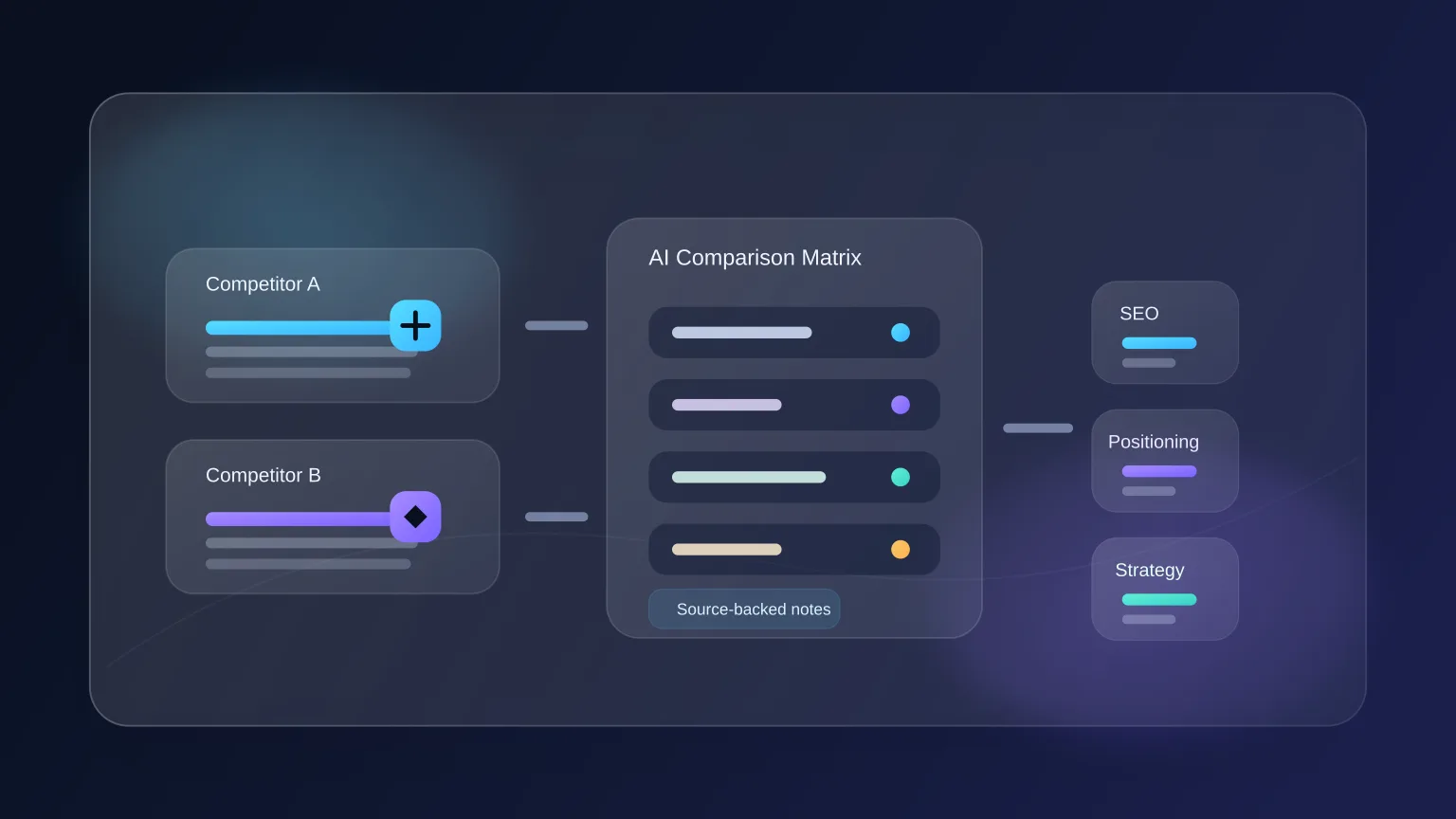
Competitor research usually breaks down in one of two ways.
Either it becomes shallow and reactive, with a team copying a few headlines and calling it a market view, or it becomes too heavy to repeat, which means nobody updates it until the strategy is already stale.
AI helps in the middle.
It can compress a large amount of public material, surface patterns faster, and help teams compare messaging, offers, and content coverage without spending days inside notes. But the value comes from structure, not from asking a model to “analyze the competitors.”
This guide shows a practical AI workflow for competitor research in 2026.
Start with the questions, not the companies
Most competitor research is too broad.
Before gathering material, decide what you actually need to learn. Usually that means one of these:
- how competitors position themselves
- which customer problems they emphasize
- what topics they own in search
- how they package pricing or plans
- where their content or product story is weak
If the questions are vague, AI will produce vague summaries.
Step 1: Build a small competitor set
Do not start with twenty companies.
A practical set is:
- 3 direct competitors
- 2 indirect or adjacent competitors
- optional 1 aspirational player with stronger execution
That gives enough contrast without overwhelming the review.
For each company, gather only the material that actually shapes perception:
- homepage
- key product or service pages
- pricing page if relevant
- blog or resources hub
- comparison pages
- help center or onboarding docs when workflow fit matters
Step 2: Separate facts from interpretation
One of the simplest improvements you can make is keeping raw inputs separate from AI summaries.
Store:
- page excerpts
- page URLs
- notes from manual review
- AI-generated summary
- analyst interpretation
That structure matters because competitor research often gets reused later in content strategy, sales messaging, or product planning. If nobody knows which part came from the source and which part was inferred, the research becomes hard to trust.
Step 3: Use AI to normalize the comparison
This is where AI creates real leverage.
Different companies describe similar things in different language. One says “workflow automation.” Another says “team productivity.” A third says “operations acceleration.” A human reviewer can spot the pattern, but doing it repeatedly is slow.
AI is useful for normalizing those differences into a shared comparison framework such as:
- target audience
- core promise
- proof points
- product or service category
- price positioning
- tone and level of sophistication
Once each competitor is summarized against the same structure, comparison becomes much easier.
Step 4: Map content coverage gaps
For SEO and editorial teams, this is often the most valuable part.
Use AI to review competitor blog hubs, resource pages, or landing pages and group them by topic cluster:
- beginner education
- commercial comparison content
- workflow tutorials
- decision-stage pages
- industry-specific use cases
Then compare that map to your own coverage.
The point is not to copy their roadmap. The point is to see:
- which topics are overcrowded
- which angles they all use
- which important questions nobody answers well
- where your site can publish something more useful or more specific
Step 5: Look for repeated messaging patterns
The strongest signal in competitor research is rarely an individual sentence.
It is the pattern that shows up repeatedly across pages:
- the same pain point appears everywhere
- the same persona is being targeted
- the same feature becomes the lead story
- the same objection keeps getting preempted
AI is especially useful for spotting those repeated patterns across dozens of pages. That gives strategy teams a clearer picture of market narratives without reading everything from scratch each time.
Step 6: Use AI to draft comparison notes, not strategy conclusions
At this stage, AI can help create useful outputs:
- one-page competitor summaries
- message comparison tables
- topic gap lists
- positioning snapshots
- first-pass internal briefing notes
What it should not do is deliver the final strategy conclusion by itself.
A model can tell you that several competitors emphasize speed, collaboration, or compliance. It cannot tell you whether your company should respond by matching that positioning, differentiating from it, or ignoring it.
That depends on product truth, audience fit, and business direction.
A simple competitor research prompt structure
The prompt matters less than the framework, but a good structure usually includes:
- who the audience is
- which competitor is being reviewed
- which source pages are included
- the exact dimensions to compare
- the output format you want
- a request to separate direct observations from interpretation
That last point is important. It makes the output much easier to validate.
Common mistakes
The most common errors in AI-assisted competitor research are predictable:
- asking for insight before collecting enough source material
- mixing direct competitors with unrelated companies
- copying positioning language instead of understanding it
- treating homepage messaging as the whole business
- using AI summaries with no link back to source pages
The workflow gets better when every insight can be traced back to something visible and reviewable.
Where this workflow fits
This kind of research is especially useful for:
- content planning
- SEO gap analysis
- landing page rewrites
- messaging refreshes
- sales enablement notes
- category education strategy
It is less useful when a team is looking for hidden product insight that is not publicly visible. AI cannot recover what competitors do not publish.
A repeatable operating cadence
Competitor research should not be a once-a-year presentation.
A better rhythm is:
- quick monthly updates for the closest competitors
- quarterly full refresh for positioning and topic coverage
- event-based reviews when a competitor launches a major new page, feature, or pricing model
That keeps the research alive without turning it into constant noise.
Final takeaway
The best use of AI in competitor research is not replacing strategic thinking. It is making comparison work faster, more structured, and easier to repeat.
When the team starts with clear questions, uses a shared framework, and keeps source material separate from interpretation, AI turns competitor research from a vague exercise into something operational.